


When consumers reach for their wallets today, they often do it virtually rather than literally.
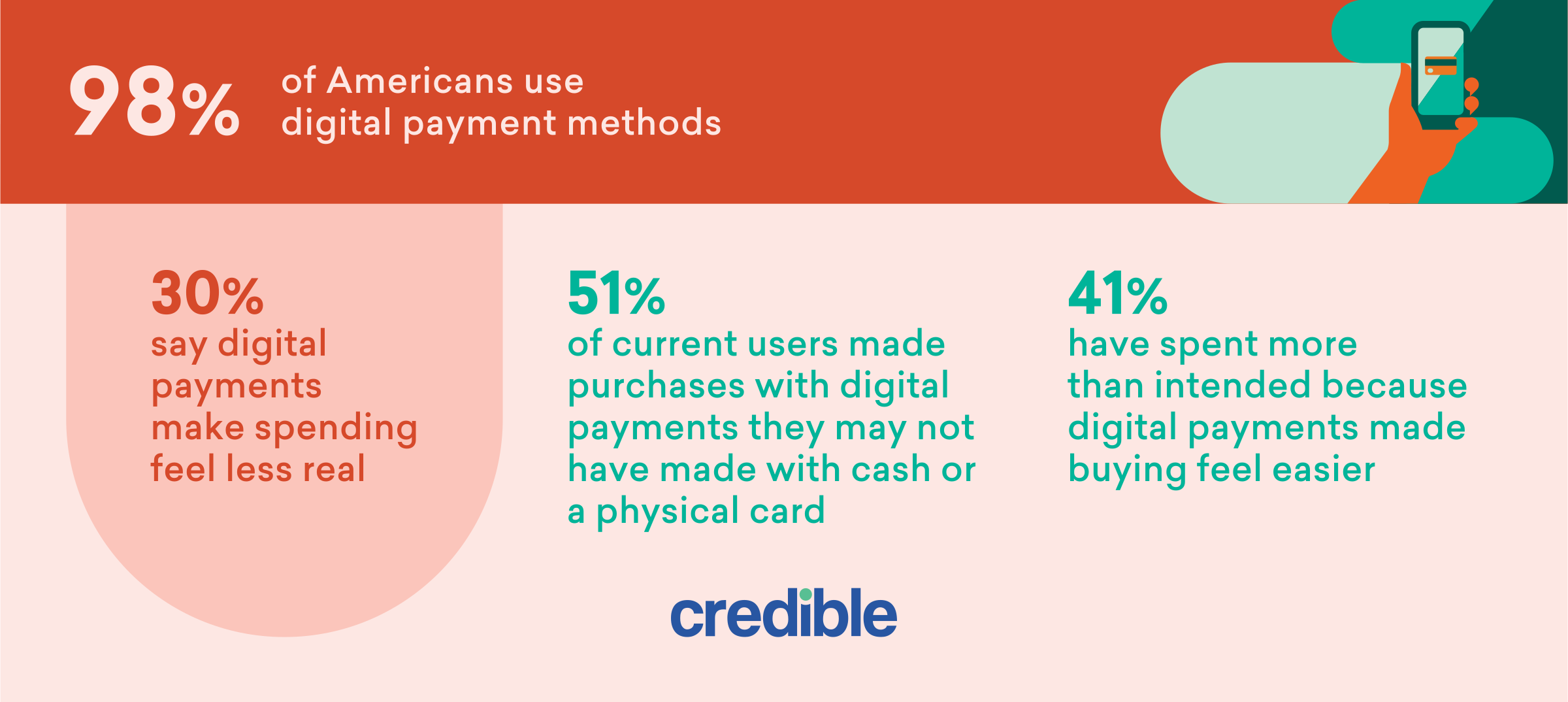
Nearly all Americans (98%) use digital payments, according to a recent Credible survey. The survey data aligns with global trends showing that the use of digital payment apps and digital wallets has expanded rapidly since 2019. The survey asked over 1,000 U.S. adults how digital payments affect their budgeting and spending, particularly over the holidays. Key takeaways include:
- More than half (51%) say they’ve used digital payments to make a purchase they wouldn’t have made with cash or a physical card.
- Almost half (49%) say digital payments make holiday impulse purchases easier.
- Nearly 60% of digital payment users are surprised to see how much they’ve spent.
- 41% lose track of their holiday budget among the multiple digital payment methods they use.
Digital payments make spending feel less real for many Americans
Beyond providing a convenient checkout process, digital payments are changing Americans’ spending behavior.
More than half of survey respondents report making purchases with digital payments they may not have made with a physical credit card or cash, suggesting an effect on impulsivity. And 30% say digital payments make spending feel less real. When spending feels less real, shoppers are less likely to stay grounded in their budgets — 41% report spending more than intended because digital payments made buying feel easier.
Shopping online may further distance shoppers from reality, as they interact with visual representations of physical goods. Fifty-five percent said they’re more likely to make impulse purchases online than in-store when paying digitally.
Counteracting the effect of digital payments on impulse spending may require a behavioral strategy. “As a shopper, you need to slow down the experience,” says Martin Lynch, president of the Financial Counseling Association of America, a nonprofit network connecting consumers with free credit counseling. “One study found that nearly 70% of items left in checkout for a day were never actually purchased.”

Tip
“Make it a policy never to complete a purchase until an item has been in an online checkout cart for at least 24 to 48 hours.” — Martin Lynch, president of the Financial Counseling Association of America
Some payments companies are even adding digital guardrails against impulse spending. “For the past decade, payments companies have competed on removing every possible step between wanting something and buying it,” says Charles Stanton, CEO of X8C, a marketing agency for fintech and AI companies. “The better providers are adding small but deliberate interventions and steps that protect the customer. For example, a confirmation above a spending threshold, a nudge when a category budget is nearly gone, or a short delay on a first payment to a new merchant.”
But right now, such guardrails are the exception and not the norm. Until then, "one way to make spending feel 'real' is to pay with cash," says Barry Bridges, personal loans editor at Credible. "Say you're holiday-shopping for a particular person. Try setting a dollar limit, then withdraw that exact amount from an ATM and go shopping. You'd be surprised how some old-fashioned guardrails can help you stay within a budget and make your spending decisions more intentional."
When making purchases, shoppers most commonly use these digital payment methods:
- PayPal (88%)
- Venmo (57%)
- Apple Pay (48%)
- Zelle (46%)
- Cash App (41%)
While shoppers use digital payments less commonly in-store than online, about a third of Americans use tap-to-pay for in-person shopping most of the time, while 30% use it sometimes.
Nearly 6 in 10 Americans get a shock when they review recent transactions
Spending is so easy that many Americans don’t even realize how much they’re spending — 59% say they have been surprised by their spending total after reviewing recent transactions.
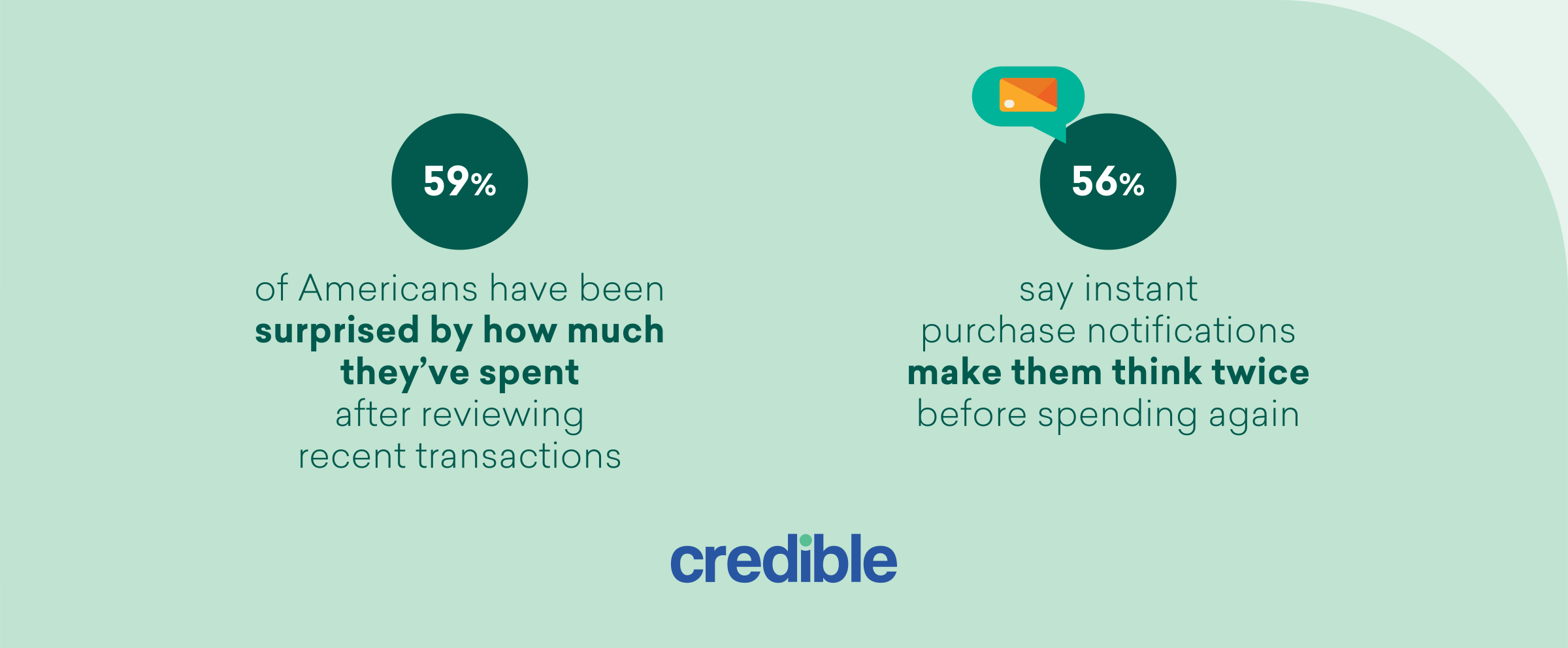
Over half (56%) say instant purchase notifications make them think twice before spending again. But they can’t prevent impulse spending altogether.
Impulse purchases are particularly likely to occur in certain spending categories. Among Americans who report using digital payment methods, 64% report impulse spending on food, takeout, or delivery, 40% say they pulled the trigger on entertainment purchases, and 38% spent impulsively on clothing. Holiday gifts (30%) and travel (20%) were also common categories for impulse buys.
But shoppers need to actively prevent impulse spending no matter what payment type they choose. “Regardless of payment method, impulse purchases have to be addressed before you open a door or click a link,” says Charles Hoff, financial literacy counselor at DFCU Financial.
70% budget for the holidays, yet 41% lose track of holiday spending
Americans expect to spend a median of $500 on the holidays in 2026, with nearly a quarter planning to increase their spending from last year. While most (70%) create a budget for the holidays, digital tools that have made shopping more convenient have also made it harder to track spending and stick to a budget. Forty-one percent say they’ve lost track of spending across apps, digital wallets, or payment accounts.
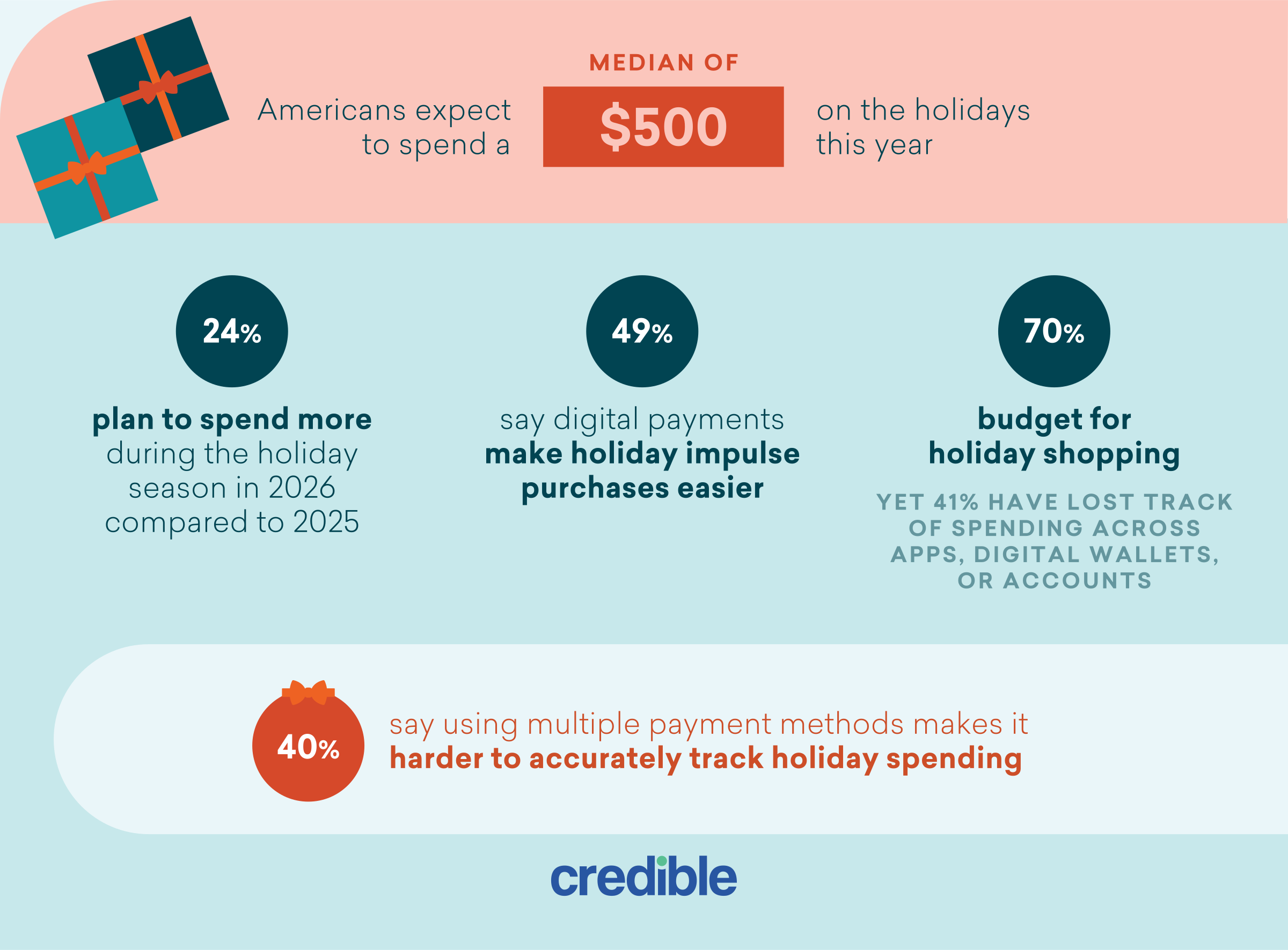
Two in five Americans report that using multiple payment methods makes it difficult to keep track of holiday spending: 21% say they use three apps or digital wallets for holiday spending, while 39% use two. When family members share access to credit cards and payment methods, it can be especially tough to stay financially organized.
“Set a budget together for each member of the family, and emphasize that no one is allowed to exceed their allotted amount,” suggests Lynch. “I also recommend starting with a review of last year's expenses so that everyone is aware of their own spending needs.” Be sure to hold one another accountable, as the ease of digital payments combined with holiday marketing may work against you.
Nearly half of Americans say digital payments make holiday impulse purchases easier. And retailers design shopping events like Black Friday to trigger impulsive spending by creating a sense of urgency and scarcity around the advertised promotions — 54% of Black Friday shoppers make one or more impulse purchases, according to Capital One Research.
68% pay for holiday gifts with digital apps or wallets
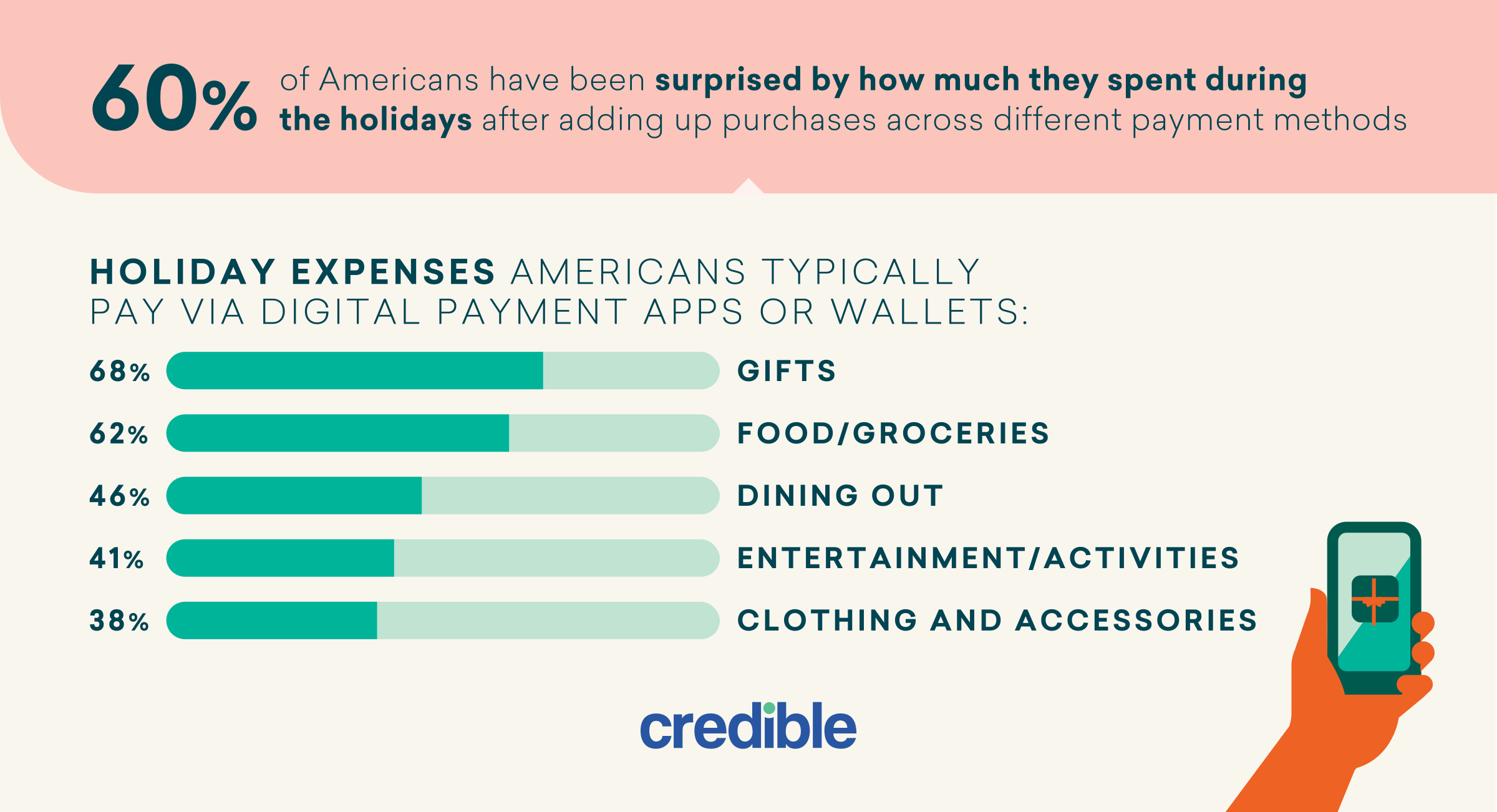
While Americans most commonly used digital payment apps or wallets to pay for gifts (68%), a significant share (62%) also paid for food or groceries using digital payment methods during the holidays. Three out of five were surprised by their total holiday spend after adding up purchases across payment methods.
If you're straying from your holiday budget, reviewing your transaction history can help you adjust course. Most Americans report checking their holiday spending at least once a week, with 31% checking it several times. But more frequent monitoring may be prudent when you’re spending more frequently and in higher amounts (like during the holidays).
The most common monitoring tools Americans use are:
- Transaction alerts (54%)
- Spending notifications (42%)
- Low-balance alerts (35%)
"Your banking app may have some budgeting tools that you haven't been taking full advantage of," says Bridges. “Check your online dashboard to see if it provides things like breakdowns of spending by category, purchases from merchants you don't typically buy from, and monthly cash flow. You might be able to get a broad overview of how much money you're spending, what you're spending it on, and where you're spending it.”
But with purchases spread across multiple payment methods, tracking can still be difficult. Sixty-nine percent of holiday budgeters say they’d be more likely to stay within budget if they could see all their holiday transactions in one place.
Stanton says that advances in technology can help, particularly with family budgets. “Longer term, open banking and multi-currency wallets that pull accounts together will make a genuinely single family view much more realistic.”
Examples include:
- Honeydue: A free budgeting app for couples that allows you to link your accounts, set a shared budget, and jointly track your spending
- YNAB: A budgeting app (shorthand for "You Need A Budget") with advanced reporting features that allows you to share your linked accounts and spending breakdown with up to 6 people
- PocketGuard: A money management app that links your accounts, tracks your expenses, and lets you know how much is safe to spend
If you don’t want to download another app, Stanton says, “the easiest approach during the holiday season is to pick one card or one wallet for all gift and holiday spending, give each family member a virtual card or sub-account under it with a set limit, and check that one view weekly.”
A 2025 Credible survey found that 25% of Americans took on debt for the holiday season.
If you overspend this year, take a practical approach to managing holiday debt. Keep up with your minimum payments to avoid credit damage, and if you’ll need to carry a credit card balance, consider a balance transfer card or debt consolidation loan to reduce the cost of repayment.
Methodology
In October 2026, Credible commissioned Digital Third Coast and Prolific to conduct a survey of 1,003 adults across the U.S. about their experiences with digital payment methods. Among respondents, 49% identified as male, 50% as female, and 1% as non-binary/rather not say. The respondents represented 49 states and Washington, D.C., and had a median age of 38.
For media inquiries, contact [email protected].
Fair use
When using this data and research, please attribute it by linking to this study and citing Credible.
