


Federal student loans require at least half-time enrollment to be eligible, which generally means taking at least six credit hours each semester. If you’re enrolled less than half time or only taking a few classes, private student loans may still be an option, depending on the lender.
Here’s what to know about finding the best student loans for part-time enrollment, whether you’re attending half time or less.
Compare private student loan rates
Can I get a student loan as a part-time student?
If you're enrolled for fewer than six credit hours, you fall below the half-time threshold for federal loans, including Direct Subsidized Loans, Direct Unsubsidized Loans, and parent PLUS loans. Still, it’s worth submitting the FAFSA to see whether you qualify for grants, scholarships, or other financial aid that can help cover your costs
Private student loans may also be an option. Some lenders, including College Ave and Abe, offer loans to students enrolled less than half time, while other lenders require at least half-time enrollment.
To qualify for a private student loan, you’ll typically need good credit and sufficient income. If you don’t meet a lender’s requirements on your own, applying with a creditworthy cosigner may improve your approval odds and help you qualify for a lower interest rate.

Good to know
A part-time student is enrolled in fewer credits than their school requires for full-time status. For example, if your school considers 12 credits full time, taking fewer than 12 credits would make you a part-time student.
Full-time vs. part-time enrollment: How does it affect financial aid?
Whether you enroll full- or part-time affects more than your class schedule. It determines which types of financial aid you can access, how quickly your loans enter repayment, and how long it takes to earn your degree.
These are the main differences so you can see where part-time status helps, and where it limits your options:
Your enrollment status is determined by the number of credit hours you're taking. A part-time student is generally one who's taking fewer classes than their school's definition of full-time enrollment. The Department of Education classifies full-time enrollment as at least 12 credit hours and half-time enrollment as at least six credit hours per term.
If your school uses “clock hour” programs or another nonstandard enrollment system, you can contact the school to find out what it considers full-time or half-time. Some schools consider 24 clock hours per week full-time enrollment, while schools with a quarter system may consider 36 quarter hours per academic year to be full-time.Keep in mind that many lenders prefer to issue larger loans over smaller ones, which may make it more difficult to qualify for a part-time student loan.
The rejection rate for private student loan applications of less than $2,000 is around 40%, compared with 13% for loan amounts of $15,000 or more, according to data compiled by Credible.

Important
Grad PLUS loans are not available to new borrowers as of July 1, 2026. Parent PLUS loans will still be offered, but the loan limits have been lowered to $20,000 per year per dependent, with an aggregate limit of $65,000.
If you don’t qualify for federal student loans, you can look for private lenders that offer loans for students enrolled less than half-time. You'll generally need good to excellent credit to qualify for a private student loan. Some lenders offer private student loans for bad credit, but these loans generally come with higher interest rates compared to the rates offered to borrowers with good credit.
If you decide to take out private student loans to pay for school as a part-time student, be sure to consider as many lenders as possible to find the right loan for you.
No matter if you take out federal or private student loans, be sure to consider how much the loans will cost you over time. This way, you can plan for any added expenses.
How much can I borrow in part-time student loans in 2026-27?
Federal annual loan limits vary by your year in school, loan type, and dependency status (dependent vs. independent). Starting with the 2026-27 school year, those limits are reduced if you're enrolled less than full time.
Your school divides the credits you’re enrolled in for the year by the credits it counts as a full-time year, then applies that percentage to your limit. For example, at a school where 24 credits makes a full-time year, a first-year dependent undergraduate with a $5,500 annual limit would get:
- 18 credits (three-quarter time): 75%, or $4,125
- 12 credits (half time): 50%, or $2,750
Your school rechecks your enrollment before each disbursement, so if you drop a class in the fall, the amount of money you can get in the spring disbursement may be reduced. The reduction applies to Direct Subsidized and Unsubsidized loans and to grad PLUS loans for students who still qualify for them, but not to parent PLUS loans.
How to choose a part-time student loan
It’s typically best to start with federal student loans. But if you’ve exceeded your federal loan limits, you may need to turn to private student loans. When evaluating part-time student loan options, consider the following factors:
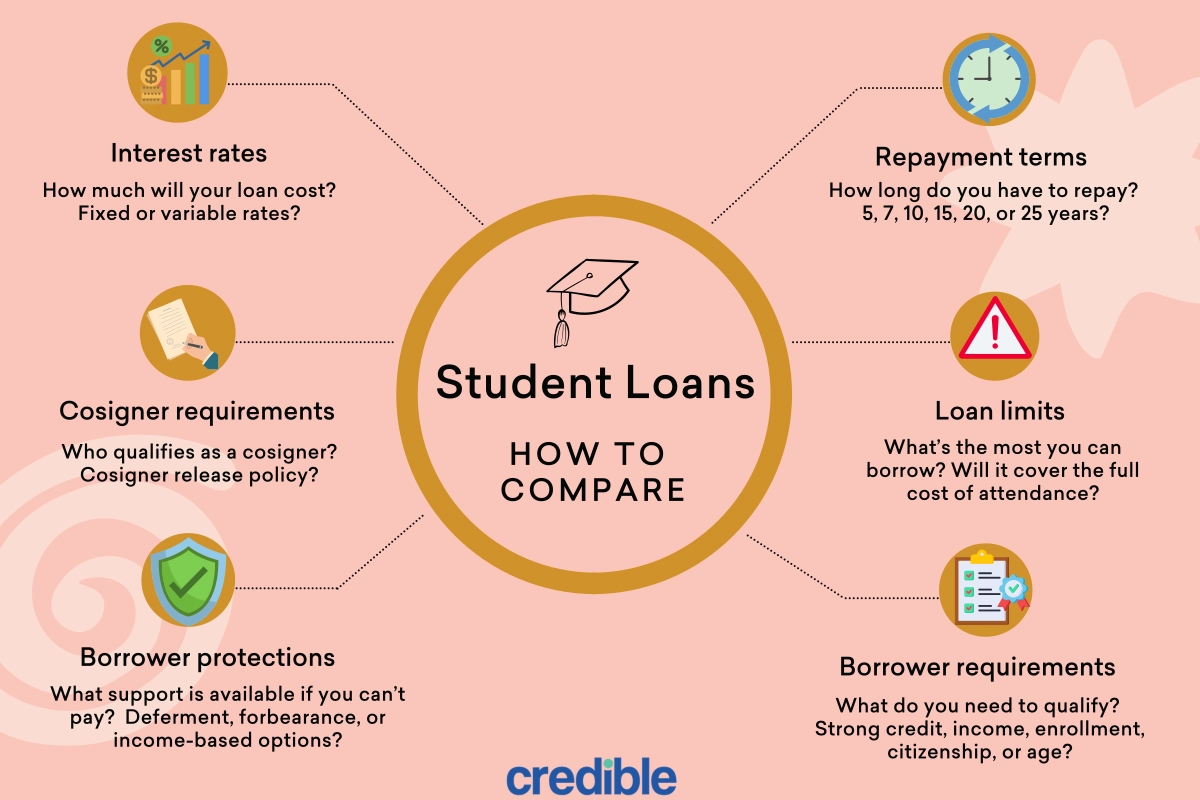
- Interest rates: Private student loans can have fixed or variable interest rates, and minimum and maximum rates vary by lender.
- Loan limits: The loan amount you’re offered depends on your credit, enrollment status, cost of attendance, and other factors.
- Repayment plans: Private lenders may offer the option to make full payments, interest-only payments, or fixed payments while you’re enrolled in school. Check repayment terms for how long you have to repay the loan.
- Borrower requirements: Pay attention to any fees the lender charges. Common fees include late fees, returned payment fees, and insufficient funds fees.
- Cosigner requirements: Find out whether you need a cosigner to get approved for a loan. It's also worth noting if they offer a cosigner release.
- Borrower protections: Not all lenders offer hardship options such as forbearance if you’re struggling to make payments, so it’s a good idea to ask potential lenders about this.
In addition, pay attention to any fees the lender charges, like late fees, returned payment fees, and insufficient funds fees. Look for any discounts the lender offers for enrolling in autopay or meeting other requirements. Rate discounts can help you save on your overall loan cost.
Editor insight: "If you’re comparing private loans for part-time enrollment, don’t focus on the advertised rate alone. I recommend checking whether the lender will fund your exact enrollment level and whether taking fewer credits changes your loan amount, repayment options, or eligibility. A low rate won’t help if the loan doesn’t fit how you’re attending school"
— Renee Fleck, Student Loans Editor, Credible
Borrowing tips for part-time students
If you need help paying for part-time school, follow these steps to maximize free aid and federal funding before turning to private student loans:
- Fill out the FAFSA: To apply for federal student loans and other federal aid, you'll need to complete the Free Application for Federal Student Aid (FAFSA). How much you qualify for in federal student loans will depend on your financial information, enrollment status, dependency status, and what year you are in school.
- Take any scholarships or grants first: You might qualify for school-specific college scholarships or grants through the FAFSA. Unlike student loans, you won't have to worry about repaying these types of financial aid. You can also find scholarships and grants elsewhere — such as through local or national businesses or nonprofit organizations.
- Opt for federal loans next: If you still need to borrow money to cover your school expenses, federal student loans are usually a good place to start. This is because federal student loans come with federal benefits and protections, including access to income-driven repayment plans and student loan forgiveness programs. Your school will let you know what federal student loans you're eligible for after you submit the FAFSA.
- Use private loans to fill the gaps: If you've exhausted your scholarship, grant, and federal student loan options, private student loans could help fill any financial gaps. A private student loan is also likely your only student loan option if you're enrolled less than half time.
You'll generally need good to excellent credit to qualify for a private student loan. Some lenders offer private student loans for bad credit, but these loans generally come with higher interest rates compared to the rates offered to borrowers with good credit.

Good to know
You may not qualify for the maximum student loan amount, especially as a part-time student. Your school calculates your cost of attendance and subtracts your Student Aid Index and any financial aid received to determine how much you can borrow.
What happens to my student loans if I drop below half-time?
For most federal and private student loans, dropping below half-time status generally means you'll have to begin repaying your loans.
Before you drop any classes, make sure to double check how it'll affect your enrollment status and whether you'll need to start making student loan payments.
If your student loans have a grace period (typically six months), you'll have that much time before you must start making payments if you drop below half time.
Alternative financial aid for part-time students
If student loans aren’t an option, you still have other ways to help cover the cost of school:
- Scholarships: Many scholarships require full-time enrollment, but some private scholarships are available to part-time students. Use scholarship search sites like Fastweb, GoingMerry, and Bold.org to filter through awards for part-time students.
- Grants: Grants, like scholarships, don’t have to be repaid. You can find grants for part-time students, though award amounts are typically smaller than those for full-time students. Federal grants you may be eligible for include the Pell Grant, Federal Supplemental Educational Opportunity Grant (FSEOG), and TEACH Grant. You can also get grants through your state, school, or private organizations.
- Part-time work: Income from a part-time job can help you cover some of your school expenses. Even a few hours a week can make a meaningful difference.
- Employer tuition reimbursement: Many employers offer tuition reimbursement benefits. Check with your HR department to see what’s available. Keep in mind that these programs often have requirements, such as staying with the company for a certain period after completing your coursework or choosing a program related to your job.
Why trust Credible?
The Credible editorial team is independent and unbiased. Partners do not influence our editorial content. To help you find the best student loan for your situation, we conduct thorough research and analyze thousands of lender data points. Using data-driven methodologies, we score criteria that are important to you. This allows us to objectively rank student loan lenders and products. To learn more, read our methodology below.
Methodology
To determine the best part-time student loan lenders, Credible collected more than 1,000 data points on two dozen companies and evaluated lenders on several different categories: repayment options, eligibility, interest rates, loan terms, and customer support. Based on our findings, we assigned a score out of five stars to each lender. Below are the weightings assigned to the general categories for the best student loan companies — which comprise individual criteria that are also weighted.
- Repayment options: 30%
- Eligibility: 25%
- Interest rates: 20%
- Loan terms: 15%
- Customer support: 10%
While the best lender for you will depend on your unique needs and financial circumstances, these findings should help answer your questions and assist you in your search for the best student loan.
Learn more about our methodology.
FAQ
What is considered a part-time student?
Open
What is half time enrollment?
Open
Can you get student loans if you’re part time?
Open
Which part time student loan is the best?
Open
Is there a downside to being a part time student?
Open
What is considered half time for student loans?
Open
How much of my Pell Grant will I get for part time?
Open
Can I get a scholarship if I’m enrolled part time?
Open
Can I use the FAFSA as a part time student?
Open


