


Americans owed a collective $18.8 trillion in household debt as of the second quarter of 2026, according to the Federal Reserve Bank of New York, with non-housing consumer debt at an all-time high of $5.19 trillion. Despite rising costs on key expenses like gas, electricity, and health insurance straining household budgets, many Americans spend discretionary income on non-essentials like dining out and shopping.
A recent Credible survey asked more than 1,000 adults about their reasons for borrowing, their spending habits, and their plans for repaying debt. The takeaways include:
- 83% of the respondents carry one or more kinds of debt, including mortgages, personal loans, credit cards, student loans, and Buy Now, Pay Later (BNPL) financing.
- More than half (55%) think debt is unavoidable for most people.
- More than two-thirds of respondents with debt (71%) are counting on future income to manage repayment.
The most common type of debt is credit card debt (77% of respondents who carry debt), which can be particularly costly if you carry a balance.
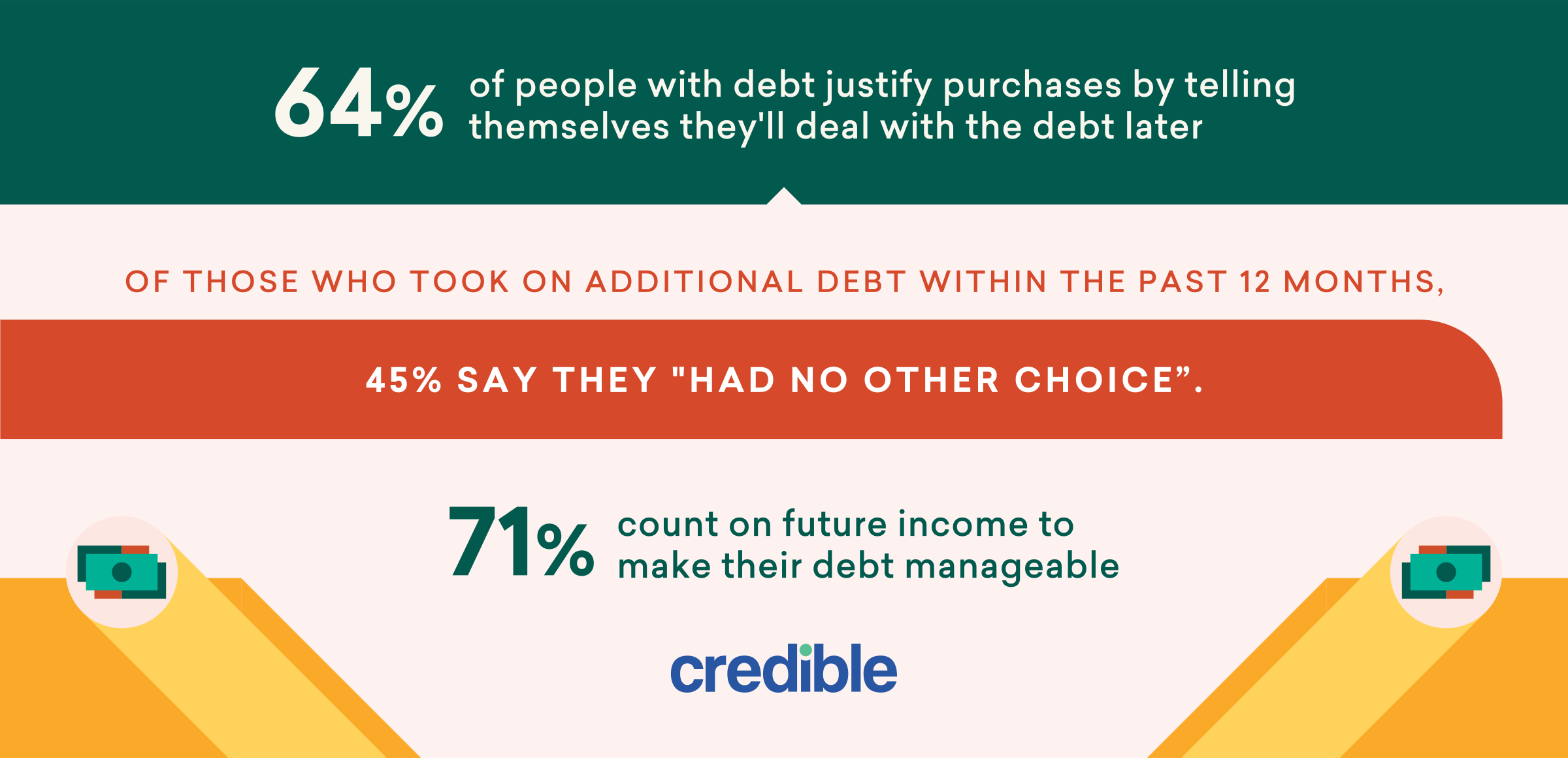
64% justify debt by telling themselves they'll deal with it later
Many Americans who carry debt balances see it as a problem for their future selves to manage. Nearly two-thirds (64%) of survey respondents with debt justify purchases by telling themselves they'll deal with the debt later.
A phenomenon known as hyperbolic discounting may have an effect — research has found that some people disproportionately value smaller immediate rewards like new purchases over larger long-term rewards like financial security. As evaluating delayed payoffs is a complex mental calculation, some people may make impulsive spending decisions based on “guesstimations.”
“The human brain is hardwired to favor immediate rewards as opposed to delayed gratification,” says Dipesh Patel, certified financial therapist at Dipesh Patel LCSW Counseling. This can cause people to downplay the future pain of debt repayment against the immediate joy of buying something new.
Most people responding to the survey are also optimistic about their future pay — 71% count on future income to make their debt manageable. At the same time, almost half feel that their current income isn’t sufficient to stay on top of today’s expenses. Of those who took on additional debt within the past 12 months, 45% say they "had no other choice."
83% of Americans have debt, 55% say it is unavoidable for most
More than four in five survey respondents reported having debt, and more than half said that debt is an unavoidable problem for most people.
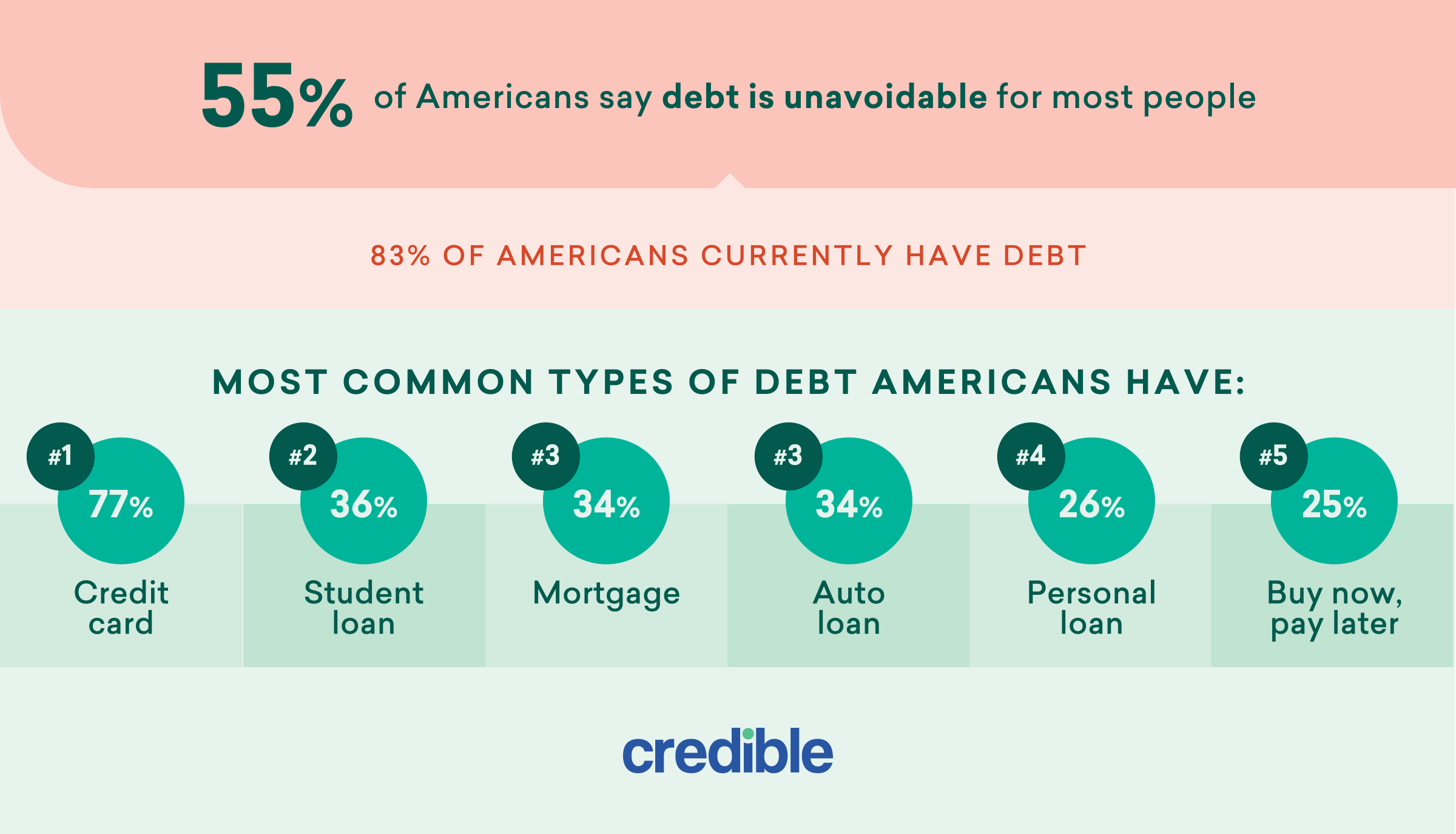
The most common types of debt they carry are:
- Credit card debt (77%)
- Student loan (36%)
- Mortgage (34%)
- Auto loan (34%)
- Personal loan (26%)
- BNPL (Buy Now, Pay Later) (25%)
The median credit card balance owed by survey respondents is $5,000.
“One reason credit card debt is especially difficult to overcome is the extremely high interest rates. The moment you miss a payment or make a partial payment, the amount starts increasing fast. Then, more of your money goes to credit card interest, and less is available to pay for regular things you need,” says Annie Hanson, accredited financial counselor at Mindfully Money. “The problem is that any new unexpected expense then has to go on the credit card, which keeps the cycle going.”
Fifty-nine percent of respondents with credit card debt rank it as their highest debt repayment priority. But repayment can be challenging when spending needs are ongoing. Increasingly, Americans have turned to BNPL financing — payment plan volume increased nearly 80% since 2023, according to the Federal Reserve. BNPL allows consumers to buy what they want while deferring payment, which many seek if they’re already in debt or have a limited cash flow. One-quarter of respondents have BNPL debt, with a median balance of $450.
Dining out, entertainment, clothes, vacations, and hobbies are popular despite debt
Many respondents with debt continue spending on non-essentials such as restaurants and food delivery (64%) and streaming subscriptions or other digital entertainment (52%).
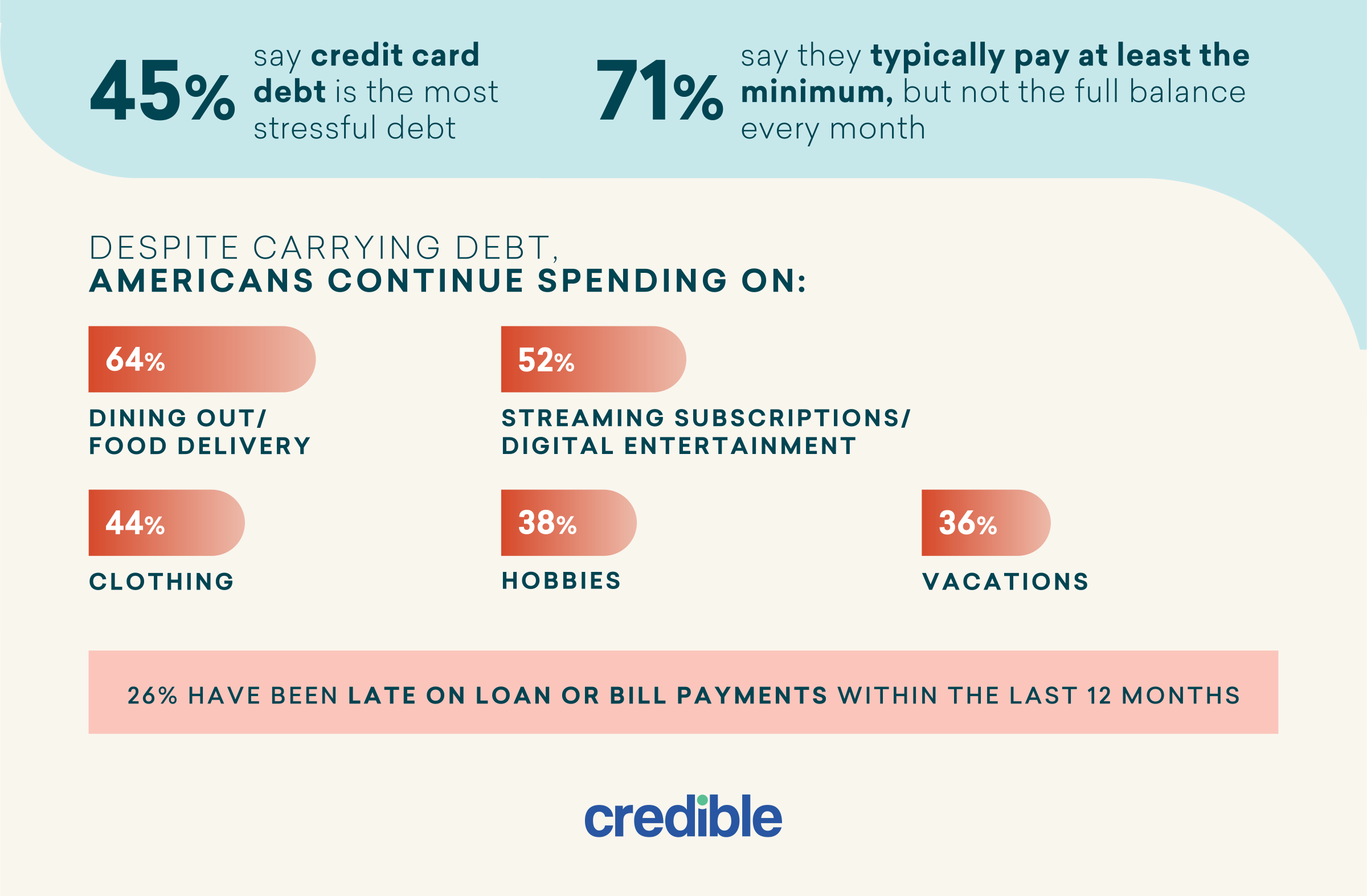
When asked which type of debt caused the most stress, 45% said it was credit card debt. Forty-five percent of respondents also reported thinking about their debt on a daily basis.
This isn’t surprising since more than three in five survey respondents (62%) currently carry a balance on one or more cards. And while 71% say they typically pay at least, or more than, the minimum monthly payment, they do not pay the full balance. That means interest accrues, potentially magnifying the problem.
But despite the emotional and financial tolls of carrying a debt balance, Americans with debt continued to spend their discretionary income, including purchases in these top categories:
- Dining out/food delivery (64%)
- Streaming subscriptions/digital entertainment (52%)
- Clothing (44%)
- Hobbies (38%)
- Vacations (36%)
Even when you’re overwhelmed with debt, it can be tough to devote your entire paycheck to debt repayment. “We all need things to look forward to or else the intrinsic and extrinsic motivation would disappear to keep working,” says Patel.
A realistic plan for debt repayment may not involve total restriction on your spending. “Many people try to live in extreme frugality, giving up everything fun or worthwhile, which isn't a sustainable way to live,” says Hanson. Instead, consider a combination of behavioral changes and debt repayment strategies.
“That might include selling items you own, reducing expenses, temporarily cutting back or canceling subscriptions, earning more, or using at least part of your bonus or tax refund for paying off debt,” says Hanson.

26% of respondents reported being late on loan or bill payments within the last 12 months, which can lead to late fees and, if your lender reports them to the credit bureaus, a major negative hit to your credit scores. Missing more than one credit card payment can also trigger a penalty APR significantly higher than the card's standard APR.
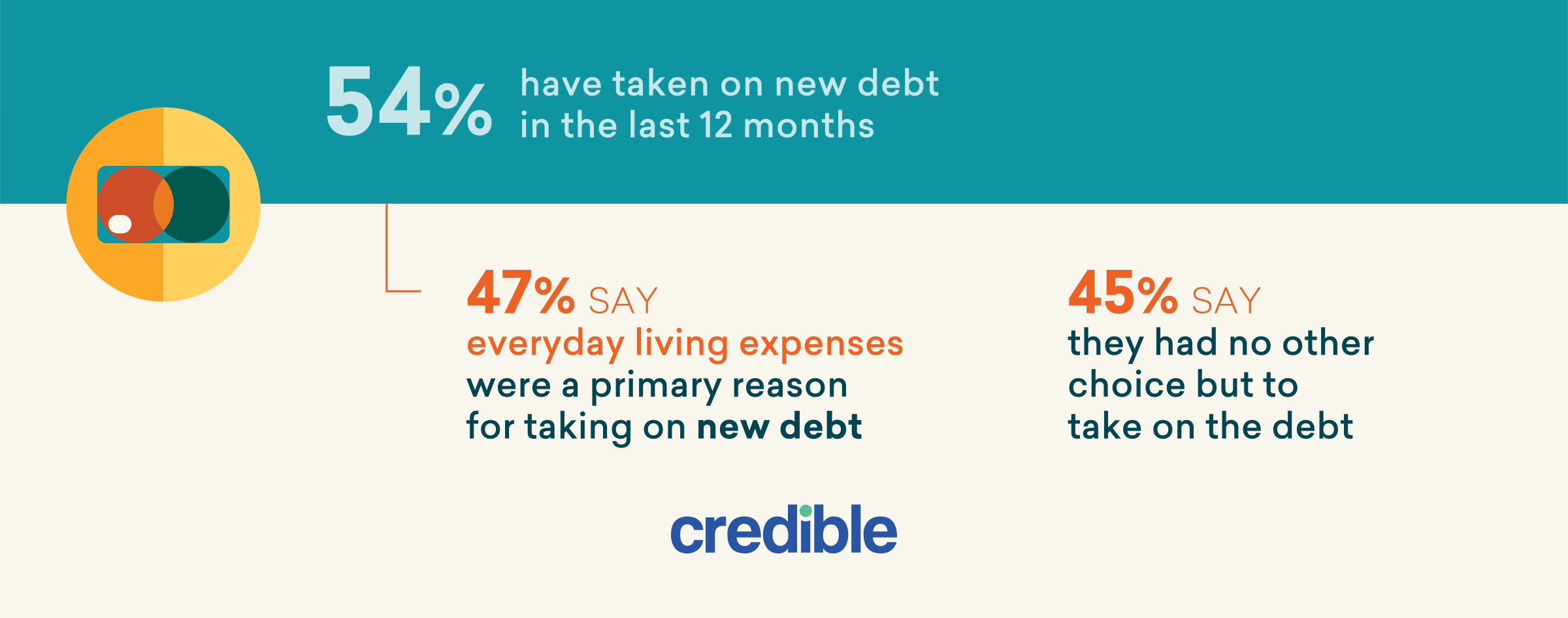
Nearly half who took on new debt used it for everyday expenses
Over half (54%) of respondents with debt took on new debt in the last 12 months — 45% of those who did say they had no other choice. But a near-majority, 47%, say everyday living expenses were the primary reason.
Based on the survey responses, expenses that many Americans consider unavoidable include:
- Housing (93%): While the rate of rent increases has slowed in most states since the beginning of 2025, homebuyers have faced higher homeownership costs. Data from the Federal Reserve Bank of St. Louis shows that the average 30-year fixed mortgage rate climbed above 7% in October. Existing home prices have risen 54% since 2020, according to the Joint Center for Housing Studies at Harvard University.
- Groceries (90%): The U.S. Department of Agriculture estimates that food prices were 2.5% higher in September 2026 than in September 2025.
- Utilities (86%): Nationwide, the average price for residential electricity rose 3.4% between August 2025 and August 2026, according to the U.S. Energy Information Administration. In comparison, average hourly earnings rose 3.1% over the same period.
Though borrowing can often feel like the only option when you have no income to pay your bills, the practice of paying for essentials on credit can quickly lead to increasing debt.
“Consumers who borrow to pay for everyday expenses often find themselves squeezed even tighter as a result of monthly payments on debt,” says Cory Nichols, financial advisor at Yes Life Financial. “This leads to additional borrowing and, as your credit score declines from higher balances, your rates on subsequent borrowing go up, making your minimum payment larger.”
Debt management and debt consolidation
If you need help reducing debt, a nonprofit credit counselor can help you with a debt management plan or budget. A debt consolidation loan is another option to potentially replace high-interest debt with a lower-cost loan.
71% believe future income will make their debt manageable
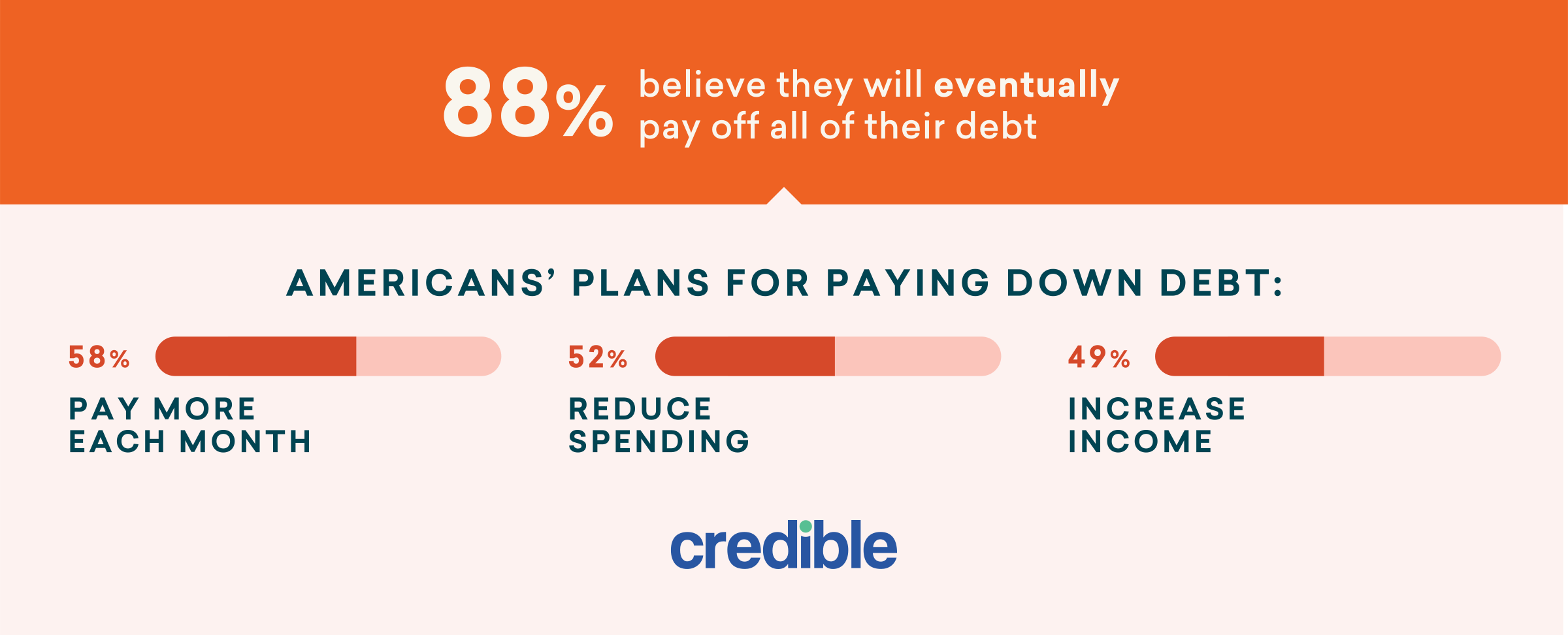
Eighty-eight percent of survey respondents with debt believe they will eventually pay off all of their debt, with plans that include paying more each month (58%), reducing their spending (52%), and increasing their income (49%). Nearly three-quarters (71%) believe their future income will make their debt more manageable.
But this expectation might be overly optimistic for the average worker; a July 2026 survey of more than 1,000 U.S. employers showed an average planned total salary increase of 3.5% per worker in 2027, just shy of the current inflation rate of around 4%.
Not only might future income be insufficient to cover today’s debt (especially if interest accrues), but “it keeps you stuck in a place of constant worry and stress,” says Hanson. “You never know when something will happen that will affect your ability to pay for those expenses or make those debt payments.”
Methodology
In September 2026, Credible commissioned Digital Third Coast and Prolific to conduct a survey of 1,011 adults across the U.S. about their experiences with debt. Among respondents, 49% identified as male, 49% as female, and 2% as non-binary/rather not say. The respondents represented 48 states and the District of Columbia and had a median age of 39.
For media inquiries, contact [email protected].
Fair use
When using this data and research, please attribute it by linking to this study and citing Credible.
