


Key findings
- Student debt has delayed major life milestones for 44% of those who currently have or previously had student loans.
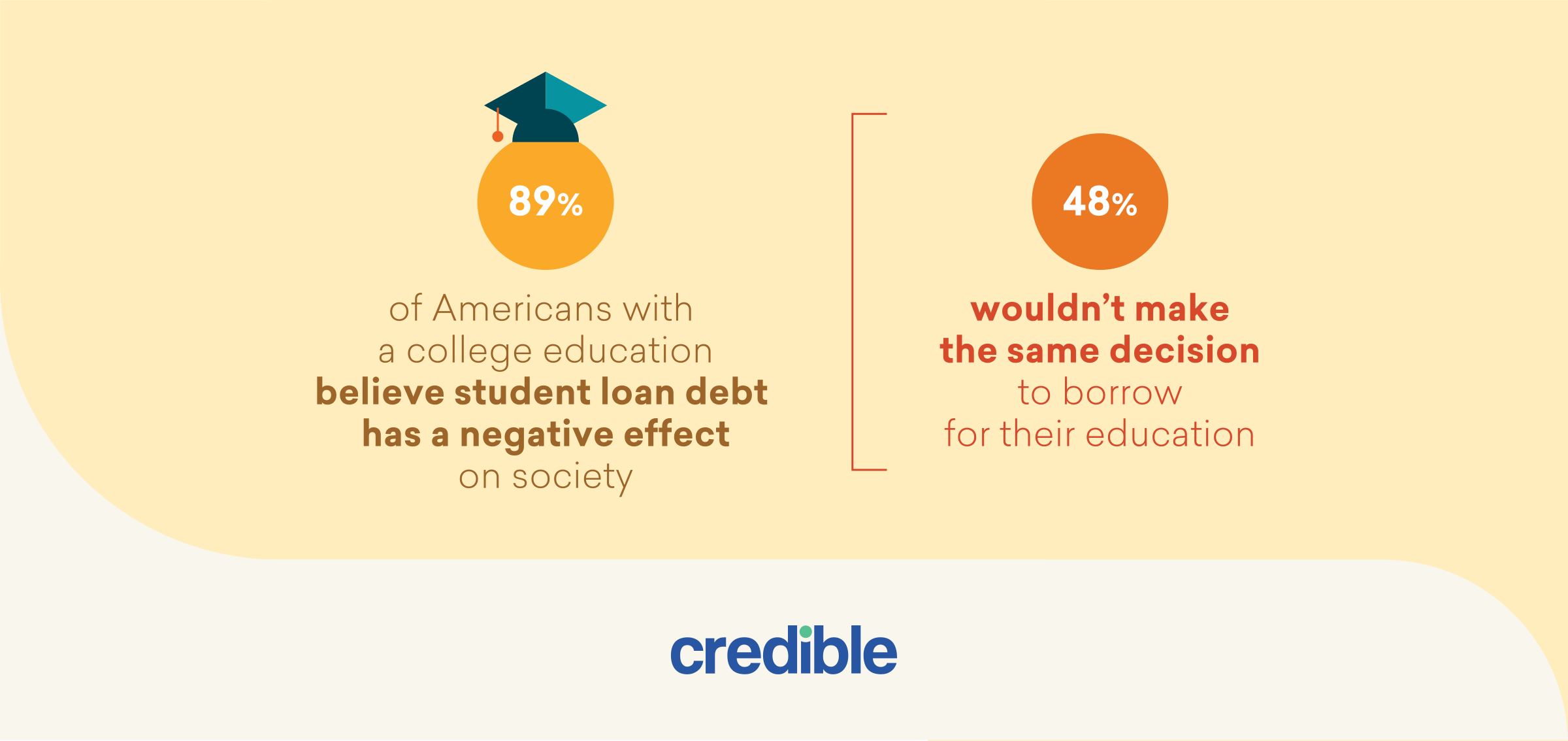
- Almost half of respondents who ever borrowed for college say they would avoid taking out student loans if they had to decide again.
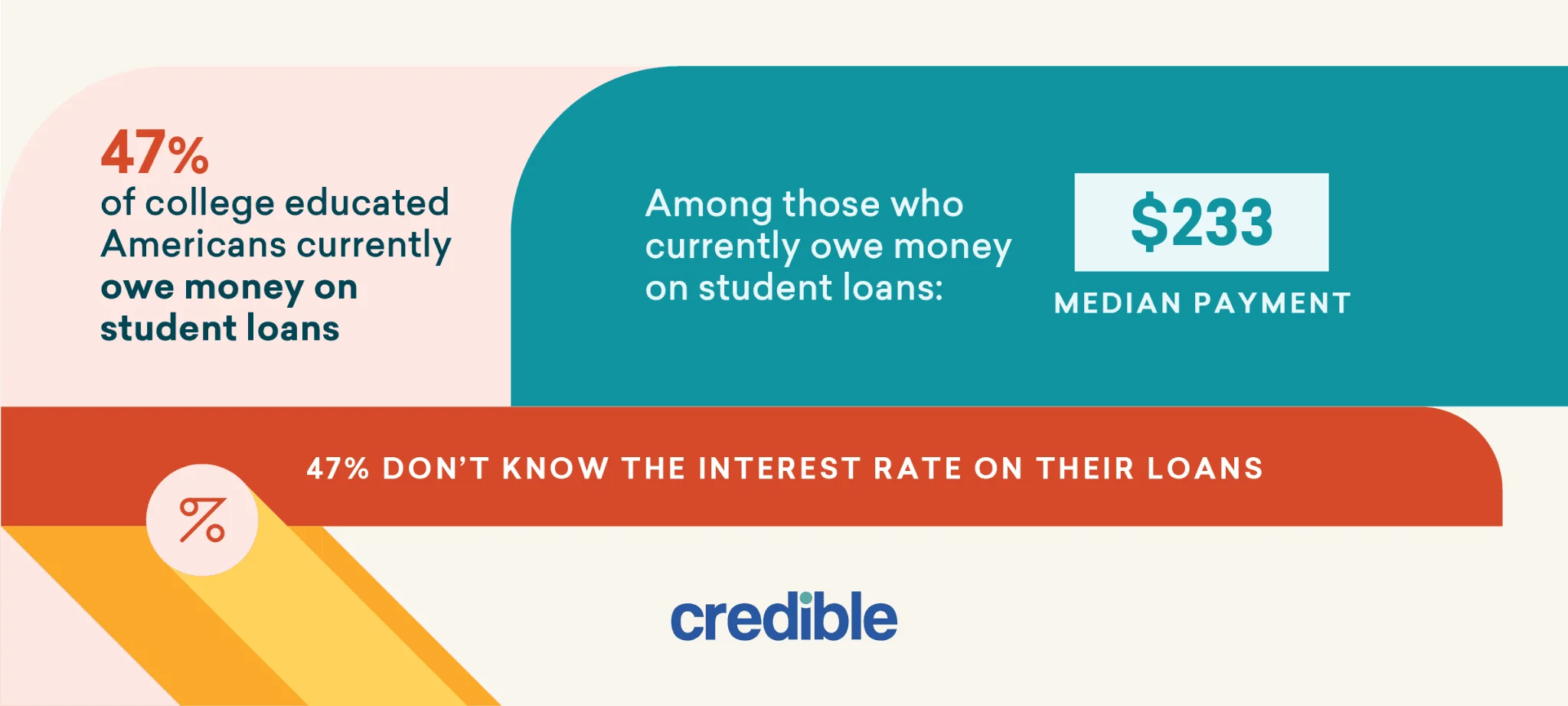
- Nearly 1 in 2 borrowers currently in repayment don't know their student loan interest rate.
For many Americans, student loan debt has become a significant barrier to major life milestones, from buying a home to saving for retirement. As millions of borrowers navigate changes in how they repay their federal student loans, a new Credible survey of over 1,000 college-educated Americans finds that 44% of respondents with past or current student loans have delayed major life milestones. Among those currently in repayment, nearly half don't know key loan details.
That knowledge gap comes at a critical moment. With the elimination of the Saving on a Valuable Education (SAVE) income-driven repayment plan, more than 6.5 million borrowers must choose a new repayment plan or be placed in a standard plan, which could result in higher monthly payments and a heavier financial burden.
44% of borrowers have delayed a major life milestone because of student debt
For many borrowers, student debt doesn't just affect their finances; it affects how they can live their lives.
Among respondents with current and past student loans, 44% say they’ve delayed at least one major life milestone because of that debt. Of those who delayed a milestone, 65% put off buying a home and more than half (52%) postponed saving for retirement. Other major milestones delayed include buying a car (45%), continuing their education (33%), living independently (25%), getting married (22%), and having children (20%).
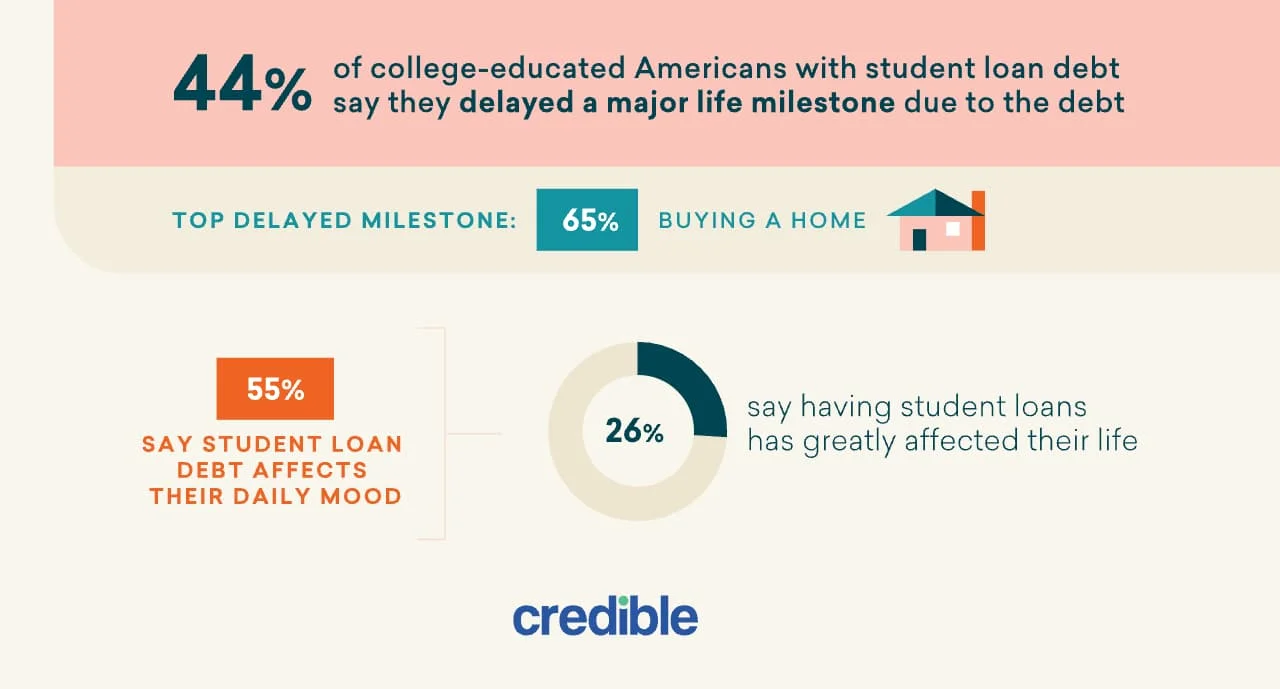
The survey also finds that student loan debt has a significant psychological impact, with just over half (55%) of borrowers reporting that it either greatly or somewhat affects their daily lives.
“Common mood or emotional changes from student loan debt can look like irritability, anxiety, avoidance, sadness, difficulty making decisions, and heaviness,” says Lindsay Bryan-Podvin, licensed master social worker and financial therapist at Mind Money Balance. “Sometimes they’ll use phrases like ‘in a fog’ or ‘weight on my shoulders.’”
The psychological toll can also create physical symptoms. Stress over student loans can show up as everything from restlessness and difficulty falling or staying asleep to appetite changes and muscle aches and pains, Bryan-Podvin adds.

Student debt at a glance
As of June 2026, 42.3 million borrowers account for over $1.7 trillion in outstanding federal student loan debt, up 3.5% from the same period in 2025, according to the Department of Education.
Most say a lower payment would get them moving again
Among those who delayed a milestone, 87% say a lower monthly student loan payment — a median of $200 less per month — would make them more likely to move forward.
Recent research suggests the same. A 2026 Florida International University study of U.S. college graduates found that those with higher monthly student loan payments were much less likely to buy a house.
“A large balance stretched over a low, manageable payment (say, through an income-driven repayment plan) may weigh less on a mortgage application than a smaller balance with a high monthly bill,” says Roy Y. Chan, an assistant professor of education at Lee University.
How borrowers can lower monthly payments
Income-driven repayment (IDR) plans tie payments to a percentage of your income for federal loans. As of July 2026, borrowers with no new Direct Loans can still enroll in Income-Based Repayment (IBR), Income-Contingent Repayment (ICR), and Pay As You Earn (PAYE) plans, which offer forgiveness at the end of the repayment period (although ICR and PAYE will be phased out by July 1, 2028). The new Repayment Assistance Plan (RAP) is the only IDR option for new borrowers.
If you were enrolled in the SAVE Plan, you should receive a notice from your loan servicer, giving you 90 days to choose a new plan. If you don't pick one by the deadline, you'll be automatically placed in a standard repayment plan, which could mean higher monthly payments.
Refinancing with a private lender is another option that can help lower your interest rate and monthly payment if you have good credit and a stable income. However, if you refinance federal loans, you’ll lose access to protections such as IDR, deferment, and eligibility for loan forgiveness — benefits the survey finds 53% of borrowers didn't know were available to them.
Bryan-Podvin adds, “As for actions to take, yes, make payments on time, but also advocate for systemic changes, like student loan reform and better support for making higher education accessible.”
Almost half of college-educated Americans wouldn’t borrow for school again
Many who borrowed to pay for their education view student debt as a lasting burden, and it has led some to second-guess their decision to borrow.
If given the opportunity to do it over again, 48% of borrowers say they wouldn't make the same borrowing decision. Meanwhile, 89% of all respondents believe student loan debt negatively affects society, with Millennials (90%) the generation most likely to hold this view.
“We spent decades telling people that the only way to have a stable income was to go to college, and to pursue it regardless of how much it cost,” says Bryan-Podvin. “At the same time, college costs skyrocketed, and people were encouraged to take out more and more loans. But now, everything is more expensive, and the loans make less and less sense.”
Nearly 1 in 2 student loan borrowers don’t know their student loan interest rate
Many borrowers are making decisions about their student debt without understanding the basics.
Almost half (47%) of borrowers currently in repayment don't know their interest rate, which is crucial to understanding how much the loan will ultimately cost. Knowing your rate also matters when comparing repayment plans — a decision many borrowers face after the SAVE Plan elimination in July 2026.
“We have had a big financial literacy problem in this country for years,” says Betsy Mayotte, president and founder of The Institute of Student Loan Advisors (TISLA). “Both families and schools should be making financial literacy more of a priority.”
Tip
Federal loan borrowers can find their interest rates by logging in to StudentAid.gov. Private loan borrowers can find their information on a loan statement or in their lender's or servicer's online account.
Despite that knowledge gap, borrowers are relatively optimistic: 71% of respondents with a student loan balance say they’re either very hopeful or at least somewhat hopeful that they can pay it off within the next 10 years.
Among the 47% of college-educated Americans surveyed who are currently repaying their student loans, the median monthly payment is $233.
Most borrowers have federal student loans
Among respondents with current or past student debt, federal loans are more common than private loans. The types of student loans you have affect which repayment options are available to you.
Federal student loans come with protections that private loans don't. It's a trade-off worth understanding before you decide whether refinancing makes sense. Student loan refinancing can lower rates for some borrowers but can close the door on federal borrower protections for others.
Refinancing federal loans comes with important trade-offs
Many borrowers assume private loans offer the same flexibility as federal loans, particularly the ability to adjust payments based on income, according to Mayotte. But that's a federal-loan-only feature, and the gap in understanding can be costly.
“Students and parents [who] take out private loans are surprised and angry when they can't afford that bill, and there's nothing the private lender can do to help them,” says Mayotte.
Nearly two-thirds of those who report having student debt now or in the past say they never looked into refinancing to lower their student loan payment, even though it could help them reach their delayed milestones.
“One of the biggest mindset shifts I help clients make is moving from simply managing debt to actively eliminating it,” says Clemons. “When we create a clear payoff plan with a specific timeline, visual progress, and automated payments, they can finally see an end in sight. That alone can be incredibly motivating.”
Methodology
In September 2026, Credible commissioned Digital Third Coast and Prolific to conduct a survey of 1,006 U.S. adults whose highest level of education completed was a technical or community college degree, an undergraduate degree, a graduate degree, or a doctorate. Among respondents, 50% identified as male, 49% as female, and 1% as non-binary/rather not say. The respondents represented 50 states and the District of Columbia, and had a median age of 39.
For media inquiries, contact [email protected].
Fair use
When using this data and research, please attribute it by linking to this study and citing Credible.


