Federal student loans are usually the best place to start if you need to borrow for community college. They offer fixed rates and borrower protections that private loans often don’t, including income-driven repayment and forgiveness. Private student loans can fill the gap when federal loans don't cover all your college costs. However, not every lender offers student loans for associate degree programs.
Find out how federal and private loans compare, which lenders fund community college, and ways to keep your borrowing costs down.
Compare current private student loan rates
What to watch out for: Federal student loans have annual and lifetime borrowing limits, but they’re often enough to cover in-district tuition at a typical community college. Avoid taking out high-interest private loans unless you have a clear gap to fill.
Can I get student loans for community college?
You can use both federal and private student loans to pay for community college, as long as you meet the lender or program requirements.
To get federal student loans, your community college must participate in the federal student aid program, and you need to be enrolled at least half time. Most community colleges participate, so many students in two-year programs qualify.
Several private lenders also offer financing for community college. At least four lenders on the Credible marketplace, including College Ave, Sallie Mae, Ascent, and Custom Choice, offer community college student loans. Other private lenders, like SoFi, require enrollment in a bachelor's degree program or higher to qualify for a loan.
Private student loans often come with higher interest rates and fewer borrower protections. They don’t offer federal benefits like income-driven repayment plans or loan forgiveness programs.
|
| |
| ||
Federal student loans for community college
If you're enrolled at least half time in community college, you may qualify for federal Direct Subsidized Loans, Direct Unsubsidized Loans, or both.
Direct Subsidized Loan eligibility is determined by financial need. The government pays interest while you're in school, during your six-month grace period, and during deferment, which can save you money.
Direct Unsubsidized Loans begin accruing interest immediately upon disbursement and do not require proof of financial need.
Congress sets the interest rate for federal student loans annually, and it’s the same for all borrowers. For the 2026-27 school year, the interest rate for federal Direct Subsidized and Direct Unsubsidized student loans is 6.52% for undergraduate students. Both loan types come with annual and aggregate student loan borrowing limits, as seen below:
Source: U.S. Department of Education
Compare: Subsidized vs. Unsubsidized Student Loans
The amount you can borrow for community college each year could be lower than the annual loan limits. Your eligibility depends on your school's cost of attendance and any other financial aid you receive, such as scholarships, grants, or work-study funds.
To get federal student loans, you must submit the Free Application for Federal Student Aid (FAFSA) each year you need funding. You provide your Social Security number, asset information, and consent for the IRS to share your federal tax information. After your application is reviewed, you'll receive a FAFSA Submission Summary with your student aid report that breaks down the federal loans and other financial aid you qualify for.
Direct PLUS Loans
A Direct PLUS Loan, also called a parent PLUS loan, lets a parent borrow for a dependent undergraduate. Your student must be enrolled at least half time at a school that takes federal aid. Parent PLUS loans require a credit check, and you can’t have an adverse credit history, such as a bankruptcy or default.
For PLUS loans disbursed after July 1, 2026, parents can borrow up to $20,000 per year and $65,000 in total for each student.
Editor insight: “Borrowing a new parent PLUS loan after July 2026 moves all of your loans to the Tiered Standard Plan. The plan doesn’t count toward Public Service Loan Forgiveness (PSLF), and you’ll no longer have access to an income-driven plan if you took out federal loans before.”
— Lisa Davis, Student Loans Editor, Credible
Workforce Pell Grants for short-term programs
If you’re in an approved short-term job training program, you can use a federal Workforce Pell Grant to help pay for your courses. Your eligibility is based on financial need, similar to a Pell Grant. Award amounts are prorated based on the length of the program, up to the standard Pell Grant amount of $7,395 for the 2026-27 academic year.
The Workforce Pell Grant applies to eligible programs that last between 150 and 599 clock hours (eight 8 to 15 weeks). Many of these programs are available at community colleges in fields like healthcare, manufacturing, and information technology. Like other Pell Grants, you don’t have to repay the Workforce Pell.
Check with your community college’s financial aid office to find out which programs qualify.
Learn More: What Is the Workforce Pell Grant?
Private student loans for community college
If you don't qualify for federal student loans or hit your borrowing limits, private student loans can help you pay for community college. However, private student loans often have fewer borrower protections and higher interest rates than federal loans.
Private student loan rate trends
Finding the right private student loan for community college
Applying with a cosigner can help you qualify and get lower interest rates. In October 2026, more than 94% of applicants who applied for private student loans through Credible added a cosigner. Cosigned applicants prequalified with an average interest rate of 7.84% — compared to 9.44% for students who applied on their own.
Best private student loan lenders for community college students
Ascent: Best for No-Cosigner Loans

To determine the best student loan companies, Credible evaluated lenders based on several different categories, including: rates and fees, loan terms, eligibility, repayment options, and customer support. We assigned a score out of five stars to each lender based on our findings.
Read our full methodology.
Min. Credit Score
Does not disclose
Fixed APR
1.99 - 18.19%
Variable APR
3.65 - 17.03%
Loan Amount
$2,001 to $400,000
Term
5, 7, 10, 12, 15, 20
Our take
Ascent stands out for offering private student loans to students without a cosigner and who have limited credit. Its Outcomes-Based Loan uses factors such as academic performance and graduation timeline instead of credit to determine eligibility. Students can also qualify for a cash-back graduation reward and choose from a wide range of repayment plans.
College Ave: Best for Extended Grace Periods

To determine the best student loan companies, Credible evaluated lenders based on several different categories, including: rates and fees, loan terms, eligibility, repayment options, and customer support. We assigned a score out of five stars to each lender based on our findings.
Read our full methodology.
Min. Credit Score
Does not disclose
Fixed APR
2.05 - 17.99%
Variable APR
3.95 - 17.99%
Loan Amount
$1,000 up to 100% of the school-certified cost of attendance
Term
5, 8, 10, 15 (20 for health professionals)
Our take
College Ave offers a wide range of borrower-controlled features that make it especially compelling for those who want predictability and planning power with their student loans. From 5- to 20-year terms and multiple in-school payment options to profession-specific grace periods, College Ave offers more structure and flexibility than many of its competitors.
Sallie Mae: Best for Specialized Loans

To determine the best student loan companies, Credible evaluated lenders based on several different categories, including: rates and fees, loan terms, eligibility, repayment options, and customer support. We assigned a score out of five stars to each lender based on our findings.
Read our full methodology.
Min. Credit Score
Does not disclose
Fixed APR
2.19 - 17.49%
Variable APR
4.00 - 17.20%
Loan Amount
$1,000 up to 100% of school-certified cost of attendance
Term
10 - 20
Our take
Sallie Mae stands out from the competition with one of the broadest selections of specialized private student loans on the market, including a new parent loan option introduced in 2026 that adds a private alternative to parent PLUS as federal borrowing caps tighten.
Custom Choice: Best for Discounts and Rewards

To determine the best student loan companies, Credible evaluated lenders based on several different categories, including: rates and fees, loan terms, eligibility, repayment options, and customer support. We assigned a score out of five stars to each lender based on our findings.
Read our full methodology.
Min. Credit Score
660
Fixed APR
3.35 - 17.17%
Variable APR
3.90 - 17.57%
Loan Amount
$1,000 up to school-certified cost of attendance (aggregate $300,000 limit for an undergraduate loan, $350,000 limit for a graduate or graduate certificate loan)
Term
5, 7, 10, 15, 20
Our take
Custom Choice offers a compelling combination of rate discounts, graduation rewards, and zero fees. You can reduce your interest rate by 0.25 percentage points with autopay, up to 0.25 percentage points with on-time payments, and request a 2% principal reduction after graduating. With no fees, cosigner release available after 12 consecutive on-time monthly principal and interest payments, and hardship forbearance, it's a good option for students seeking both savings and support.
How to get free money for community college
Student loans aren't the only way to cover the cost of attending community college. Explore other financial aid options below:
- Scholarships and grants: Scholarships and grants don't need to be repaid, which makes them one of the best ways to fund your education. Submitting the FAFSA puts you in the running for federal, state, and school-specific scholarships and grants. However, you can also apply for private scholarships and grants for even more free funding.
- Federal work-study program: If you qualify for the work-study program through the FAFSA, you can earn money to help offset your education costs. Work-study jobs are often flexible and designed to fit around your class schedule.
- State-funded aid: Many states offer financial aid specifically for community college students. For example, the California Promise helps make community college more affordable by allowing colleges to waive enrollment fees for first-time, full-time students who don't qualify for the California College Promise Grant (a separate program for low-income students).
- Employer-based tuition assistance: If you're working part- or full-time while attending community college and have already taken out student loans, consider asking your employer if it offers tuition assistance or reimbursement. Employers can provide up to $5,250 in tax-free assistance to each employee annually, which can help you pay for the principal and interest on your student loan.
Can I go to community college for free?
It’s possible to attend community college without paying tuition if your state has a grant program. As of 2026, more than 30 states offer tuition-free community college through grants. These programs generally fall into two categories:
- First-dollar funding: Covers tuition costs upfront, regardless of other financial aid you receive.
- Last-dollar funding: Kicks in after other financial aid is applied, filling any remaining tuition gaps.
Keep in mind that these programs generally only pay for tuition, meaning you might need to pay for additional educational expenses, such as room and board. However, some states are expanding their programs to help with these costs. Massachusetts, for example, offers allowances of up to $1,200 for books and supplies based on the student's income level.
Community college student loan repayment options
You can choose from several student loan repayment options, depending on whether you take out federal or private loans.
Federal student loan repayment options
Federal student loans for community college offer the most repayment flexibility. Borrowers with federal loans disbursed before July 1, 2026, may continue to access other plans until July 1, 2028.
If you take out Direct Subsidized or Unsubsidized Loans on or after July 1, 2026, you have two repayment options:
- Tiered Standard Plan: Fixed monthly payments over 10 to 25 years, depending on your balance when you enter repayment.
- Repayment Assistance Plan (RAP): Payments are 1% to 10% of your adjusted gross income, minus $50 a month for each dependent. Any remaining balance is forgiven after 360 qualifying payments (30 years), and forgiven amounts may be taxable.
Private student loan repayment options
Private student loan repayment options vary by lender. Many allow you to defer payments while you’re in school, while others require full, interest-only, or fixed monthly payments. Repayment terms typically range from five to 20 years, and borrowers can often choose between fixed or variable interest rates.
Tips for managing community college loans
As you navigate community college debt, the tips below can help.
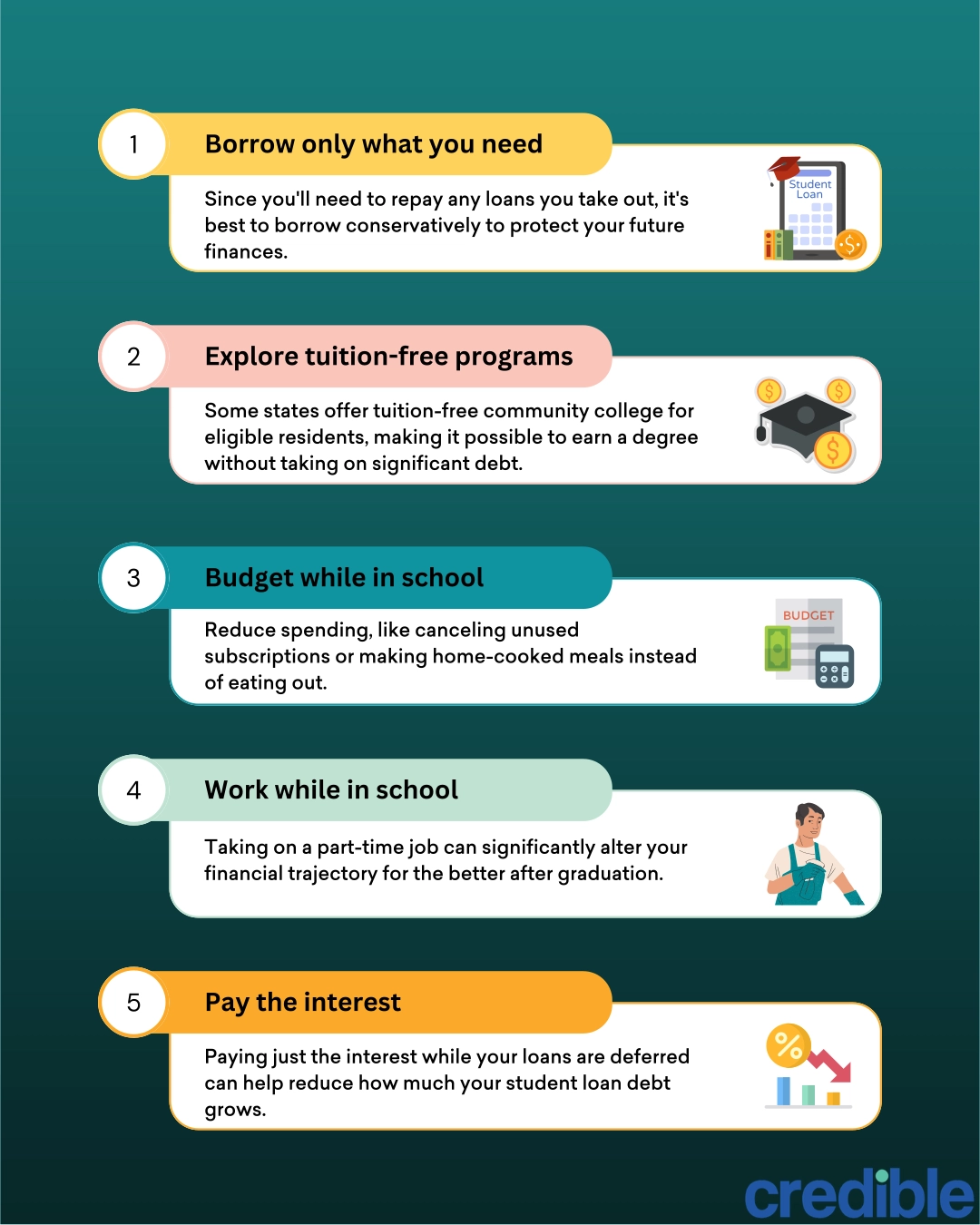
Borrow only what you need
Since you'll need to repay any loans you take out, borrow conservatively to protect your future finances.
“Investigate all tuition assistance programs or local scholarships specifically tailored to community college students,” says Dr. Shaan Patel, founder and CEO of Prep Expert.
“These sometimes go under the radar and can be less competitive than larger scholarships. Next, stay focused on completion — taking only classes that align with your degree path helps avoid extra semesters,” adds Patel.
Explore tuition-free programs
Some states offer tuition-free community college for eligible residents, making it possible to earn a degree without taking on significant debt. These programs often have specific requirements, such as maintaining a certain GPA or meeting income limits.
If your state has a tuition-free program, it's worth exploring. Contact your state's education agency or your college's financial aid office to learn about eligibility criteria and how to apply.
Budget while in school
Building and sticking to a budget during community college can help you borrow less and keep your finances in check. Start by calculating your expected expenses, including tuition, textbooks, and living costs, and create a plan to cover them. Look for ways to cut costs, such as canceling unused subscriptions or cooking at home instead of dining out.
“Textbooks are another ghost expense because you can easily cut expenses by balancing buying online with asking professors which ones are really required,” says Reyna Gobel, author of CliffNotes’ “Graduation Debt: How to Manage Student Loans and Live Your Life.”
Work while in school
Balancing work and school is often a challenge. But working while in school lets you use your earnings to offset educational costs and living expenses. Even a part-time job can significantly improve your financial trajectory after graduation.
Pay the interest while in school
Paying the interest on your student loans while you’re still in school can make a big financial difference over time. Even small monthly interest payments can keep your loan balance from growing. By graduation, you’ll owe closer to what you actually borrowed, not hundreds or thousands more.
How to apply for community college loans
If you decide to apply for community college loans, use the steps below as a guide.
- Submit the FAFSA: This form is key to unlocking federal student loans, grants, and work-study opportunities. Schools use your FAFSA information to determine your eligibility for federal student aid.
- Search for private scholarships and grants: Apply for scholarships and grants from private organizations, community groups, and your school. These funds don't need to be repaid, so they're one of the best ways to minimize your out-of-pocket costs.
- Fill gaps with private loans: If your scholarships, grants, and federal loans don't fully cover your costs, private student loans can help. Compare lenders to find loans with competitive rates, flexible repayment terms, and minimal fees.
Additional considerations for community college borrowers
Beyond comparing federal and private loan options, it’s important to be aware of several key factors that can affect borrowing for community college:
- Loan limits: Federal limits are the same at 2- and 4-year schools, but you can't borrow more than your school's cost of attendance minus other financial aid. If you’re a part-time student, you may receive a prorated amount.
- Repayment terms: Because community college programs are shorter, repayment may begin sooner than at a 4-year school. Make sure you understand grace periods and repayment schedules.
- Refinancing options: Some private lenders may allow refinancing once you transfer to a 4-year program or graduate from a 2-year program.
Methodology
To determine the best community college student loan lenders, Credible collected more than 1,000 lender data points and evaluated them across several categories: repayment options, eligibility, interest rates, loan terms, and customer support. Based on our findings, we assigned a score out of five stars to each lender. Below are the weightings assigned to the general categories for the best student loan companies — which comprise individual criteria that are also weighted.
- Repayment options: 30%
- Eligibility: 25%
- Interest rates: 20%
- Loan terms: 15%
- Customer support: 10%
While the best lender for you will depend on your unique needs and financial circumstances, these findings should help answer your questions and assist you in your search for the best student loan.
Learn more about our methodology.
Why trust Credible?
The Credible editorial team is independent and unbiased. Partners do not influence our editorial content. To help you find the best student loan for your situation, we conduct thorough research and analyze thousands of lender data points. Using data-driven methodologies, we score criteria that are important to you. This allows us to objectively rank student loan lenders and products. To learn more, read our methodology below.
FAQ
What is the average cost of community college?
Open
Can community college students get loans?
Open
How do student loans work for community college?
Open
Do all community colleges accept FAFSA?
Open
Do community colleges offer student loans?
Open
Can I use federal student loans for part-time community college programs?
Open
How can I maximize financial aid for community college?
Open
What are the best private student loans for community college?
Open
Are student loans worth it for community college students?
Open
Does Sallie Mae work with community colleges?
Open